
[Southeast University News Network, May 31] (Correspondent: Yi Xuan) Prof. Yao Honghong of the School of Medicine of Southeast University and Associate Professor Wang Jianhong from Kunming Institute of Zoology, Chinese Academy of Sciences (CAS) have achieved new progress in the study of pathological mechanism and intervention strategy of ischemic stroke. Related research result was published in Circulation on May 22, 2020 with the title of “Extracellular Vesicle-Mediated Delivery of CircSCMH1 Promotes Functional Recovery in Rodent and Nonhuman Primate Ischemic Stroke Models”.
Ischemic stroke, a kind of cerebrovascular disease resulting from vascular occlusion that may cause partial or whole brain dysfunction, is an important cause of death and disability among adults in China. Thanks to the medical advancement, the mortality of patients with ischemic stroke is decreasing year by year, but the majority patients are still confronted with such obstacles as limb sensorimotor and emotional cognition. At present, there is still a shortage of drugs that may promote neurological function repair after ischemic brain injury, and the mechanism of neurological function repair after stroke has not yet been elucidated.
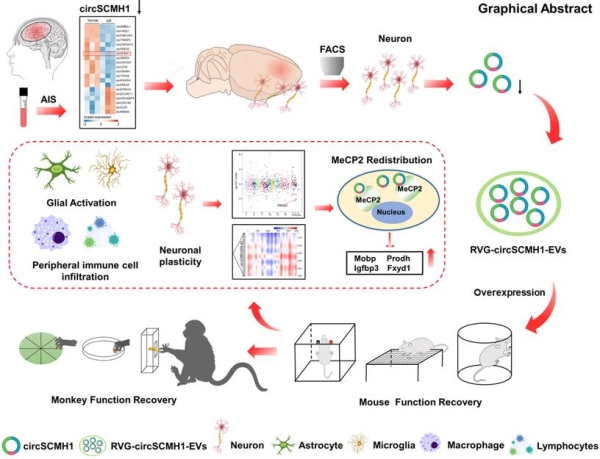
The topic team led by Prof. Yao Honghong applied the circRNA chip screening technology to first screen the expression profile of circular RNA (Circular RNA, circRNA) from the plasma samples of patients with acute ischemic stroke and found that the expression of circSCMH1 was significantly reduced. Further expansion of the sample testing and correlation analysis revealed that the level of circSCMH1 in plasma would have the potential of assessing the prognosis of ischemic brain injury. Afterwards the team further constructed the extracellular vesicle (EV) targeting the maincenter and wrapping the circSCMH1, found that circSCMH1-EVs could significantly promote the repair of brain injury among small animal models (tMCAO, dMCAO and PT) suffering from different strokes. In addition, the team also verified in nonhuman primate models with strokethat circSCMH1-EVs can significantly improve the neurological function injury and promote the motor function recovery among rhesus macaques with stroke. Further study on mechanism indicated that circSCMH1 could inhibit MeCP2 from entering the nucleus by combining with MeCP2, thereby promoting the expression of Mobp, Igfbp3, Fxyd1 and Prodh, etc., the downstream target genes of MeCP2.
This study reveals a new mechanism of neurological function repair after ischemic brain injury from the perspective of circular RNA, provides a new insight for studying the targeted delivery strategy of circular RNA tothe maincenter, and also provides a new target for developing new drugs for the treatment of ischemic stroke. This research was co-directed by Prof. Yao Honghong and Associate Professor Wang Jianhong with the graduate student Yang Li and the young teacher Han Bing as the co-first authors. The research was supported by National Key R&D Program, the National Natural Science Foundation of China and Jiangsu Innovation & Entrepreneurial Team, etc.
Paper’s link: https://www.ahajournals.org/doi/10.1161/CIRCULATIONAHA.120.045765
(Editor-in-charge: Wu Chan, reviewed by: Li Xiaonan)